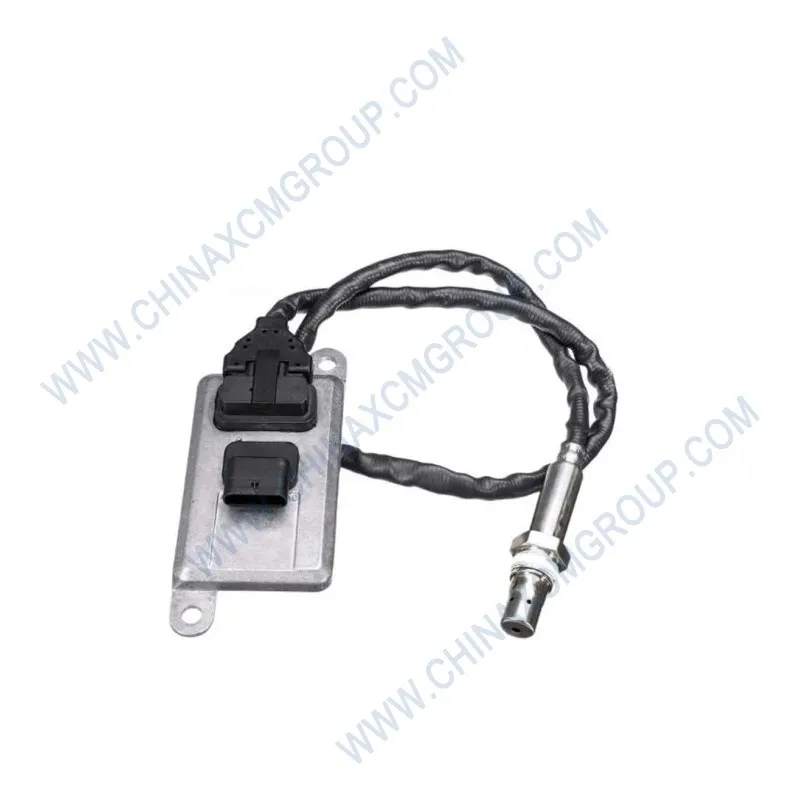
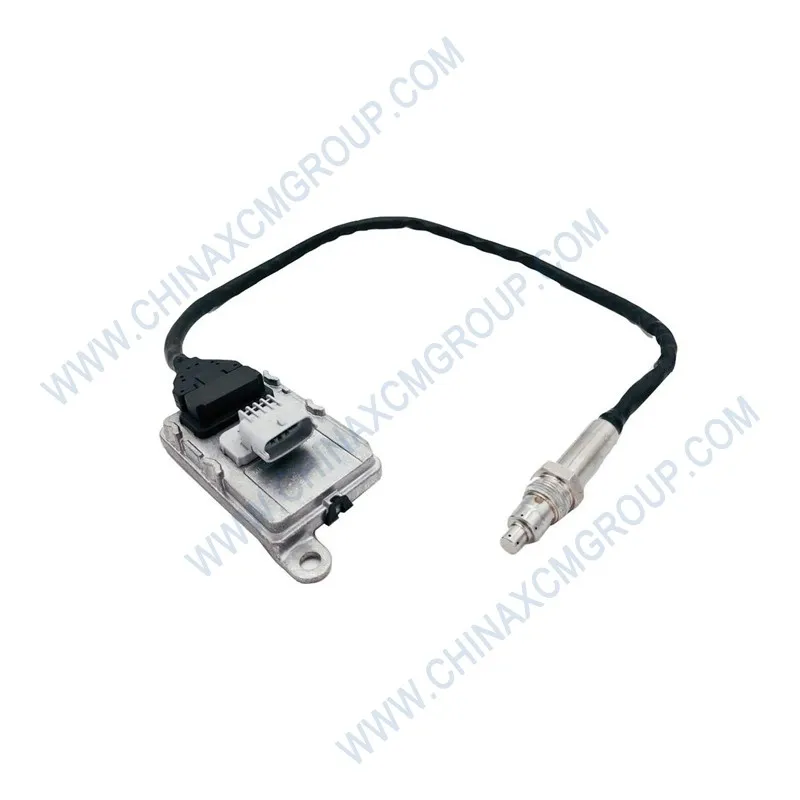
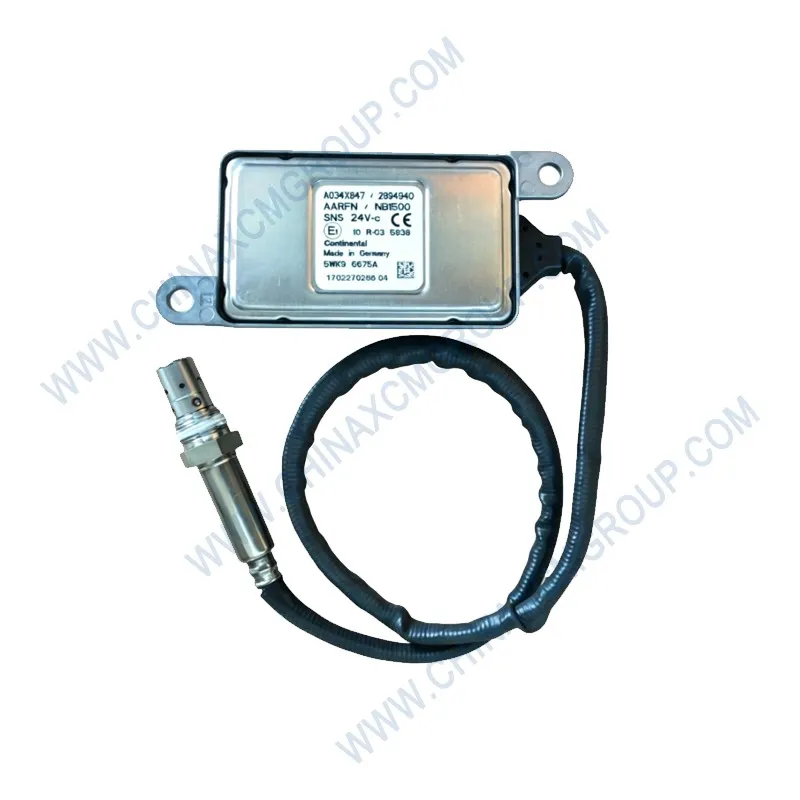


The genuine XCMG NOx Sensor with OEM number 800172897 is a high‑precision emissions monitoring component engineered for XCMG articulated dump trucks, wheel loaders, and off‑highway equipment equipped with Tier 4 Final / Stage V diesel engines. This sensor accurately measures nitrogen oxide (NOx) concentration in the exhaust stream after the selective catalytic reduction (SCR) catalyst, providing critical feedback to the engine control unit (ECU) for precise diesel exhaust fluid (DEF) dosing. Featuring advanced planar zirconia ceramic technology, an integrated heater, and a robust stainless steel housing, the XCMG 800172897 NOx sensor ensures rapid warm‑up, excellent ammonia resistance, and long‑term stability in the extreme thermal and vibration conditions typical of mining and construction sites. Proper NOx sensor operation is essential for maintaining emissions compliance, preventing engine derates, and optimizing DEF consumption.
The XCMG NOx Sensor 800172897 is a critical component of the selective catalytic reduction (SCR) system, which reduces nitrogen oxide emissions by injecting DEF into the exhaust stream. The sensor continuously monitors NOx concentration downstream of the SCR catalyst, allowing the ECU to fine-tune DEF dosing. This closed‑loop control ensures that the engine meets stringent Tier 4 Final / Stage V standards while minimizing DEF consumption. A failed or inaccurate NOx sensor can lead to increased DEF usage, frequent regeneration events, or even an engine derate that severely impacts productivity.
On AD60 and AD80 articulated trucks, the 800172897 sensor is typically installed in the exhaust pipe after the SCR. Field data from mines in Nevada and Chile show that genuine XCMG NOx sensors maintain stable readings for over 6,000 hours, even in high‑dust, high‑vibration conditions. The sensor’s ammonia‑resistant coating prevents false high readings caused by NH₃ slip, which is common after active DPF regenerations.
The 800172897 NOx sensor uses a planar zirconia ceramic element with two independent pumping cells. One cell measures oxygen concentration while the other measures NOx. This differential design eliminates cross‑sensitivity to other exhaust gases. The integrated heater raises the ceramic to its operating temperature (750°C) within 60 seconds, enabling the sensor to provide accurate readings shortly after engine start. This fast readiness is essential for cold‑weather operation, where SCR systems need to begin converting NOx quickly.
The sensor’s internal electronics include an ASIC that linearizes the output and calibrates out temperature drift. The sensor communicates via CAN J1939 using XCMG‑specific parameter groups (PGNs). This digital interface eliminates analog signal degradation over long wiring runs, which is common in large articulated trucks. The sensor also supports diagnostic messages, including heater circuit status, internal temperature, and sensor health.
The XCMG NOx sensor 800172897 is a direct OEM replacement for original part numbers 800172897A, 860124587, and 860298761. It is physically and electronically identical to the sensor originally installed on Cummins QSM11, Deutz TCD, and XCMG’s own 9‑liter Tier 4 engines. The 6‑pin Deutsch connector pinout is standard: pin 1 = CAN H, pin 2 = CAN L, pin 3 = battery (+), pin 4 = ground, pin 5 = heater control (PWM from ECU), pin 6 = sensor ground.
Before ordering, verify the engine ECU calibration. Some early Tier 4 engines (2015‑2017) require a software update to accept the 800172897 sensor. XCMG provides a free ECU reflash for customers purchasing genuine sensors. Always replace the copper sealing gasket each time the sensor is removed, and torque the sensor to 50 Nm ± 5 Nm. Do not use power tools – over‑torquing can crack the ceramic.
To replace a NOx sensor, first let the exhaust system cool below 100°C to avoid burns. Disconnect the battery negative cable. Unplug the sensor connector (press the locking tab). Using a 22mm deep socket or a dedicated NOx sensor socket, unscrew the sensor from the exhaust bung. Clean the bung threads with a thread chaser and inspect the sensor tip for abnormal deposits – white deposits may indicate oil consumption, black deposits may be from over‑fueling or poor combustion.
Install the new XCMG 800172897 sensor with a new copper gasket. Apply a small amount of anti‑seize to the threads (avoid the sensing tip). Hand‑tighten until the gasket contacts, then torque to 50 Nm. Reconnect the harness, ensuring the connector clicks. Reconnect the battery. Start the engine and idle. Using a diagnostic scan tool, monitor the NOx sensor live data. The sensor should show a plausible value (e.g., 20–200 ppm at idle) and the heater current (typically 2–3 A) should be present.
If the scan tool displays “NOx sensor not ready” after five minutes, check the wiring for damage or the ECU for the correct calibration. Clear any DTCs (e.g., P2200, P2201, P2202, P2208) after replacement. Drive the machine under load for 30 minutes to allow the SCR system to relearn. If the sensor reports implausible values (e.g., always 0 ppm or >1000 ppm), perform a sensor verification using the XCMG Service Tool (part 800172897‑TOOL).
Counterfeit NOx sensors sold as 800172897 often use generic ceramic elements that are not ammonia‑resistant, causing false high readings when NH₃ is present. This leads to over‑dosing of DEF and white deposits on the tailpipe. Symptoms also include a “SCR efficiency” fault code despite normal system operation. Genuine XCMG sensors have a laser‑etched part number, a green dot on the connector body, and a holographic label on the packaging. The sensor tip has a distinct gold‑colored coating (the ammonia‑resistant layer).
Another common issue is moisture ingress into the connector. Counterfeit sensors may lack internal potting, allowing water to wick into the electronics. Genuine XCMG sensors are fully encapsulated with a yellow epoxy visible around the pins. Test the heater resistance between pins 5 and 4 – genuine sensors measure 4.5 Ω ± 0.5 at 25°C. A counterfeit may show open circuit or very low resistance.
Incorrect CAN protocol: Some aftermarket sensors use a generic J1939 broadcast but with the wrong PGN, causing the XCMG ECU to ignore the signal. The genuine sensor is programmed with XCMG‑specific message IDs. Always verify that the sensor communicates with the ECU before assuming the fault is elsewhere.
A failed NOx sensor can trigger an engine derate to 25% power (limp mode) or even a forced idle, making the machine nearly unusable. The cost of downtime for an AD60 during a 12‑hour shift can exceed $5,000 in lost production. Replacing a faulty sensor with a genuine XCMG 800172897 sensor costs approximately $285 – a small fraction of the cost of a single day of lost work.
Predictive maintenance: Use telematics to monitor NOx readings. If the sensor reports high NOx (e.g., >500 ppm) while the engine is at idle and properly warmed up, suspect sensor drift. Also, if DEF consumption increases significantly without a corresponding increase in load, the sensor may be over‑reporting NOx. Early replacement prevents wallet‑eating DEF waste and avoids emission compliance violations.
Payback analysis: A genuine NOx sensor costs ~$285. If it prevents one derate event that would cause 4 hours of downtime (lost production value $1,500) and avoids a $400 towing charge, the ROI is achieved in the first week. For fleets, stocking a spare sensor eliminates the wait for overnight shipping.
Every XCMG NOx Sensor 800172897 is manufactured in an IATF 16949‑certified facility. Each sensor undergoes 100% functional testing: calibration at 0, 100, 500, and 1000 ppm NOx using a gas bench, heater warm‑up time measurement (<60 seconds), and CAN communication verification. Sample units are subjected to 2000‑hour thermal cycling (-40°C to +850°C) and 1000‑hour salt spray. XCMG provides a 24‑month warranty against ceramic fracture or electronic failure.
Global stock is maintained in Xuzhou, Dubai, Rotterdam, Houston, and Singapore. Emergency orders ship within 24 hours. Bulk packs of 5 sensors (part number 800172897‑B5) are available for fleet customers at a 12% discount. Each sensor includes a new copper sealing gasket, anti‑seize packet, and installation instructions.
To verify authenticity, scan the QR code on the packaging – it links to the individual test certificate showing the sensor’s CAN ID, calibration coefficients, and heater current. Always insist on genuine XCMG 800172897; counterfeit sensors have been known to cause severe drivability issues and may void the engine’s emissions warranty.
XCMG engineers tested the 800172897 NOx sensor under extreme conditions: 10,000 thermal shocks from ambient to 800°C, 2000 hours of random vibration at 30g RMS, and 1000 hours of salt spray (ASTM B117). The sensor maintained reading accuracy within ±10% of baseline, and the ceramic element showed no micro‑cracking. The connector seals prevented moisture ingress even after 500 high‑pressure wash cycles. The ammonia‑resistant coating remained intact after 5000 hours of exposure to exhaust containing up to 50 ppm NH₃.
For engines that operate in very high sulfur fuel environments (above 500 ppm), XCMG offers a high‑sulfur tolerant version (suffix “-HS”) with an extra protective coating on the ceramic element. This version is recommended for trucks in regions where low‑sulfur diesel is not always available.
The sensor’s housing is designed to resist galvanic corrosion when installed in aluminum exhaust flanges. The stainless steel material also tolerates exposure to DEF and urea crystals without pitting. All internal electronics are conformal coated for moisture resistance.