
The XCMG Vs Caterpillar comparison has become the most consequential debate in the global construction equipment industry. Caterpillar, founded in 1925 and headquartered in Irving, Texas, remains the undisputed world leader with trailing twelve-month revenue of approximately $70.76 billion and a record backlog of $63 billion at the end of the first quarter of 2026. XCMG Machinery, founded in 1943 and headquartered in Xuzhou, China, has climbed to third place in the global Yellow Table rankings, with construction equipment sales of approximately $14.2 billion and a 5.8% global market share. Understanding the XCMG Vs Caterpillar rivalry is essential for fleet managers, contractors, and procurement specialists seeking to allocate capital wisely in an increasingly competitive marketplace. For the latest industry news and updates, visit China XCMG Group News. This XCMG Vs Caterpillar analysis examines company background, product range, global influence, technological progress, and performance reliability to help equipment buyers make informed decisions.
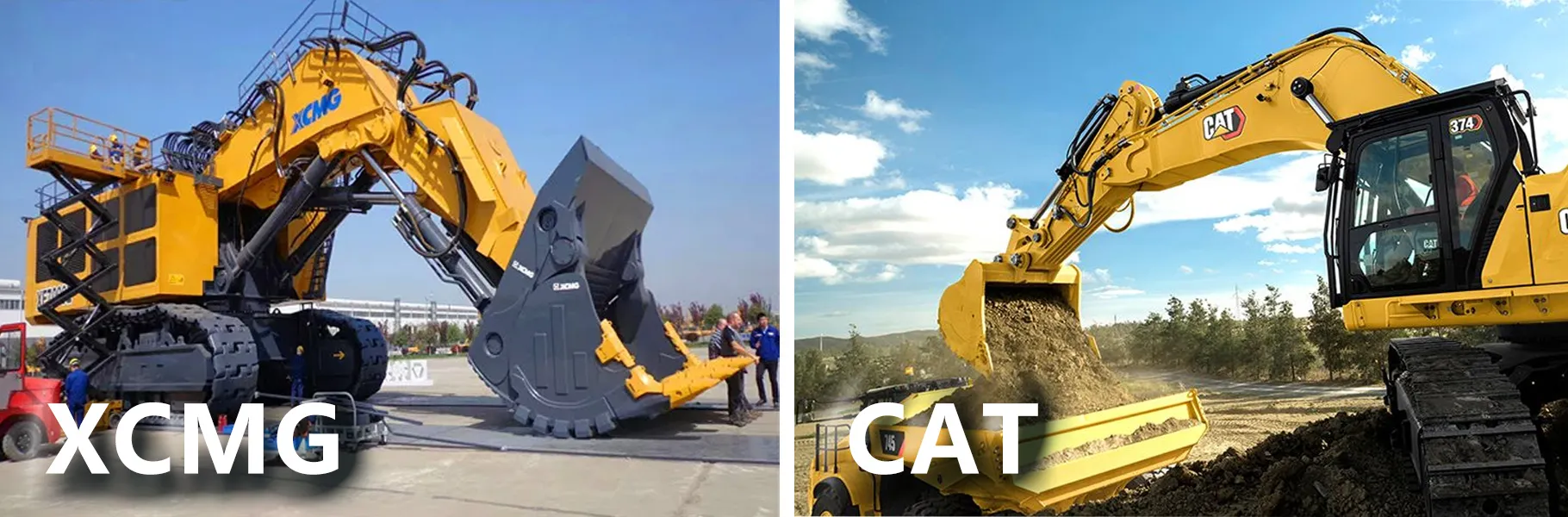
The XCMG Vs Caterpillar contest begins with fundamentally different corporate histories. Caterpillar’s origins trace back over a century. Formed in 1925 through the merger of Holt Manufacturing Company and C.L. Best Tractor Company, Caterpillar pioneered the continuous track tractor that revolutionised agriculture and construction. Today, the company operates across three primary segments – Construction Industries, Resource Industries, and Energy & Transportation – employing approximately 113,000 people worldwide. Its market capitalisation exceeds $364 billion, and its 2026 Fortune Global 500 ranking places it at number 216 with $67.6 billion in revenue. Caterpillar’s strategic direction emphasises autonomy, artificial intelligence, and after-sales service revenue, with its backlog reaching a record $63 billion in early 2026.
XCMG, formally Xuzhou Construction Machinery Group, began as a small machinery repair workshop in 1943 and has grown into China’s largest construction equipment manufacturer. The company was restructured into a joint-stock enterprise in 1993 and listed on the Shenzhen Stock Exchange under ticker 000425. XCMG’s 2026 first-half results show revenue of RMB 61.25 billion (approximately $9.03 billion), up 11.75% year-over-year, with overseas revenue exceeding 50% of total revenue for the first time. R&D investment rose 25.07% to RMB 3.30 billion, focusing on new energy, intelligent technologies, and core components. The company has been ranked among the global top three construction equipment manufacturers in KHL Group’s Yellow Table for multiple consecutive years.
The fundamental difference in background shapes the XCMG Vs Caterpillar market approach. Caterpillar leverages a century-old brand, an extensive dealer network, and premium pricing power. XCMG competes through aggressive R&D investment, rapid product iteration, and cost-effective manufacturing, targeting emerging markets and price-sensitive segments while steadily moving upmarket. In the XCMG Vs Caterpillar comparison, heritage and scale favour Caterpillar, while growth momentum and cost efficiency favour XCMG.
Product range is a critical differentiator in the XCMG Vs Caterpillar comparison. Both manufacturers offer extensive portfolios, but their strengths and coverage differ significantly.
Caterpillar’s product line is the most extensive in the industry, spanning excavators, wheel loaders, track loaders, dozers, motor graders, compactors, asphalt pavers, cold planers, off-highway trucks, articulated trucks, material handlers, pipelayers, and more. The company offers products from compact equipment such as the Cat 301.7 CR mini excavator to the massive Cat 6090 mining excavator, a 1,000-tonne class machine. Its construction equipment includes the recently introduced Cat 319 compact radius excavator and next-generation Cat 150 and 160 motor graders. Caterpillar’s depth extends into engines, turbines, and diesel-electric locomotives, providing cross-segment technology synergies. In the XCMG Vs Caterpillar product breadth contest, Caterpillar’s sheer variety of models and attachments remains unmatched.
XCMG’s product range covers six major categories: hoisting machinery, excavating machinery, loading machinery, road machinery, aerial work platforms, and non-excavating machinery. The company produces 1-tonne to 12-tonne full-series loaders, K-series skid loaders, backhoe loaders, and D-series 1.5-tonne to 49-tonne full-series crawler excavators. XCMG’s hoisting machinery is particularly strong, including the XCA4000 all-terrain crane and a full range of crawler cranes and tower cranes. The company also produces pavers, milling machines, light rollers, horizontal directional drilling rigs, concrete pump trucks, and crushing and screening equipment. XCMG has launched over 40 flagship products at major trade shows, demonstrating its commitment to full-line coverage. In the XCMG Vs Caterpillar product comparison, XCMG’s crane and concrete equipment lines are especially competitive.
Caterpillar’s advantage lies in the sheer depth of its product range, particularly in large mining equipment and specialised attachments. XCMG’s advantage lies in its rapidly expanding product line and aggressive pricing across all categories. For general construction, both brands offer competitive solutions. For highly specialised mining applications or equipment requiring the broadest attachment compatibility, Caterpillar maintains an edge. For buyers building a complete fleet from one Chinese brand with attractive pricing, XCMG offers a compelling alternative. The XCMG Vs Caterpillar product range verdict depends entirely on the specific machine classes required.
Global influence determines how quickly a manufacturer can supply machines, parts, and service – critical factors for fleet uptime and project profitability. In the XCMG Vs Caterpillar contest, global reach is a key differentiator.
Caterpillar retained its position as the world’s largest construction equipment manufacturer with $37.5 billion in construction equipment sales, representing 15.2–15.9% of total global sales. The company has held the number one position in the Yellow Table for decades, and its brand recognition remains unmatched in most markets. XCMG ranked third globally with $14.2 billion in sales and a 5.8% market share, overtaking John Deere to become the highest-ranked Chinese manufacturer in the global top five. According to the 2026 Yellow Table, Caterpillar’s total revenue of $374.94 billion and 15.7% market share dwarf XCMG’s $142 billion and 5.8% share, but XCMG’s growth trajectory is notably steeper. In the XCMG Vs Caterpillar market share comparison, Caterpillar leads by a wide margin, yet XCMG is closing the gap faster than any other competitor.
Caterpillar’s global dealer network is widely regarded as one of the strongest in any industry. With independent dealers in nearly every country, the company provides unmatched parts availability and service response. Its dealer network, combined with the Cat Financial financing arm, creates a comprehensive ownership ecosystem that few competitors can replicate. XCMG has invested heavily in expanding its global footprint. Its overseas revenue exceeded 50% of total revenue for the first time in the first half of 2026, up 21.03% year-over-year. The company has established subsidiaries, dealer partnerships, and regional warehouses in key markets across Asia, Africa, Latin America, and Europe. While still smaller than Caterpillar’s network in absolute terms, XCMG’s coverage has improved dramatically, particularly in Belt and Road Initiative countries. In the XCMG Vs Caterpillar dealer network battle, Caterpillar remains the gold standard, but XCMG is rapidly closing the gap.
Caterpillar dominates in North America, Europe, and Australia, where its premium positioning and dealer infrastructure create high switching costs. XCMG is strongest in China, Southeast Asia, Africa, and Latin America, where price sensitivity and infrastructure investment drive demand for cost-effective equipment. In the Asia-Pacific region, XCMG has leveraged localized production and financing partnerships to gain significant market share, particularly in Indonesia, the Philippines, and Vietnam. The XCMG Vs Caterpillar regional dynamic shows Caterpillar leading in mature markets while XCMG gains ground in emerging economies.
Technology is the battleground where the XCMG Vs Caterpillar rivalry is most fiercely contested. Both companies are investing heavily in autonomy, electrification, and intelligent control systems, but their approaches reflect different strategic priorities.
Caterpillar has been a pioneer in autonomous mining equipment for over a decade, with its autonomous haul trucks logging millions of operating hours. At CES 2026, the company unveiled its next era of autonomy in construction, previewing five autonomous machines – a wheel loader, dozer, haul truck, excavator, and compactor – designed to operate safely in complex construction environments. Caterpillar also introduced the Cat AI Assistant, an AI-powered partner embedded in Cat digital and onboard products to help operators take confident action. The company partnered with NVIDIA to leverage the Jetson Thor platform for real-time AI inference on construction, mining, and power equipment. Caterpillar’s investment of $25 million in workforce development underscores its commitment to preparing operators for an autonomous future. In the XCMG Vs Caterpillar technology race, Caterpillar’s autonomy leadership is currently unchallenged.
XCMG has accelerated its technology development with a focus on electrification and intelligent control. Its R&D investment rose 25.07% to RMB 3.30 billion in the first half of 2026, with revenue from L2-and-above intelligent products approaching RMB 10 billion, an increase of 25.48%. XCMG introduced its upgraded ICS 2.0 intelligent control system incorporating AI-driven functionality for grading and slope assistance. The company has developed electric and hybrid equipment, including the XC938EV pure electric wheel loader and XC978HEV hybrid wheel loader. XCMG’s intelligent logistics solution features autonomous guided vehicles (AGVs) integrating LiDAR and vision systems with 10 mm positioning accuracy. The company also unveiled the XCT50G6-1EV all-electric unmanned crane with voice recognition for intelligent interaction. In the XCMG Vs Caterpillar electrification contest, XCMG has moved aggressively with a growing lineup of battery-powered machines.
Caterpillar leads in autonomous construction and mining, with a mature ecosystem of autonomous machines and AI-powered operational tools that have been validated in real-world deployments. XCMG has made rapid progress in electrification and intelligent control, particularly in electric wheel loaders and cranes, but its autonomous construction lineup is less mature than Caterpillar’s. For buyers seeking proven autonomous solutions today, Caterpillar is the safer choice. For buyers prioritising electrification and intelligent features at a competitive price point, XCMG offers compelling options. The XCMG Vs Caterpillar technology verdict depends on whether autonomy or electrification is the higher priority.
Performance and reliability are ultimately what determine whether a machine delivers value over its operating life. Independent field data and customer reports provide valuable insights into the XCMG Vs Caterpillar comparison.
In the highly competitive 20-tonne excavator class, fuel consumption differences can significantly impact operating costs. XCMG’s XE215DA achieves comprehensive fuel consumption below 12 litres per hour through its separate pump independent control system, delivering a 7% efficiency increase and a 10% fuel reduction compared with its predecessor. Caterpillar’s Cat 320 excavator, a direct competitor in this class, is known for its C4.4 engine and advanced hydraulic system, but typically consumes slightly more fuel per hour under equivalent load. However, Caterpillar’s engines are widely regarded as more durable over extended high-hour operation, and their fuel efficiency tends to remain stable longer than many competitors. For high-utilisation mining or quarry applications, the total cost of fuel over 10,000 hours may favour XCMG, while the total cost of ownership including rebuild intervals may favour Caterpillar. In the XCMG Vs Caterpillar fuel efficiency comparison, XCMG holds an edge in hourly consumption while Caterpillar excels in long-term stability.
Caterpillar’s reputation for build quality is unmatched in the construction equipment industry. Its machines are designed for multiple rebuild cycles, and components are engineered for long service intervals. The company’s dealer network supports rebuild programs that extend machine life well beyond initial design parameters. XCMG has made substantial progress in build quality. Its excavators use Weichai or Cummins engines, ZF transmissions, and Danfoss-Rexroth hydraulic components, with actual service life in the field ranging from 15,000 to 25,000 hours. This represents a significant improvement over earlier generations of Chinese equipment. While Caterpillar machines may last longer in absolute terms, XCMG’s lower acquisition cost means that the cost per hour of operation can be competitive even with a shorter service life. The XCMG Vs Caterpillar durability comparison shows Caterpillar still ahead, but XCMG narrowing the gap with each product generation.
Caterpillar’s dealer network provides the gold standard for parts availability, with most common parts available within 24 hours in developed markets. XCMG’s parts network has expanded significantly but still lags in remote areas. However, for buyers in markets where XCMG has established a strong presence, parts availability is often adequate, and prices are typically 20–40% lower than Caterpillar OEM parts. The trade-off is that XCMG’s dealer service may be less comprehensive than Caterpillar’s, particularly for complex diagnostic and repair tasks. In the XCMG Vs Caterpillar parts and service evaluation, Caterpillar remains the benchmark while XCMG offers competitive alternatives in select markets.
The acquisition price gap remains substantial: Chinese brands including XCMG remain 20–50% cheaper than comparable Caterpillar machines. Caterpillar justifies its premium through higher resale value, longer service life, and comprehensive dealer support. For buyers with high utilisation rates and access to Caterpillar’s service network, the total cost of ownership may favour the premium brand. For buyers in price-sensitive markets with adequate XCMG support, the lower initial investment and competitive parts pricing can deliver superior return on investment. The XCMG Vs Caterpillar cost of ownership verdict depends heavily on utilisation rates, local support quality, and the buyer’s time horizon.
| Comparison Factor | XCMG | Caterpillar |
|---|---|---|
| Founded | 1943 (Xuzhou, China) | 1925 (Irving, USA) |
| Global Ranking (2026) | 3rd worldwide | 1st worldwide |
| Construction Equipment Sales | ~$14.2 billion | ~$37.5 billion |
| Global Market Share | 5.8% | 15.2–15.9% |
| Core Product Strengths | Cranes, excavators, loaders, road machinery | Full range, mining equipment, engines |
| Technology Focus | Electrification, intelligent control, autonomy | Autonomy, AI, digital ecosystem |
| Global Dealer Network | Expanding rapidly, strong in emerging markets | Industry-leading, global coverage |
| Price Positioning | 20–50% lower than CAT | Premium pricing |
| Parts Pricing | Lower cost, improving availability | Higher cost, best availability |
| Resale Value | Growing but below CAT | Industry-leading |
| Best Fit For | Cost-conscious buyers, emerging markets | High-utilisation fleets, developed markets |
Data compiled from KHL Yellow Table 2026, company financial reports, and industry field data. Actual specifications and pricing vary by region, model, and configuration.
The XCMG Vs Caterpillar decision is not about which brand is universally better, but about which brand aligns with your specific operational requirements, budget, and risk tolerance. Caterpillar remains the global benchmark for build quality, dealer support, and residual value. Its century-long heritage, 15.2–15.9% global market share, and record $63 billion backlog demonstrate the enduring strength of its business model. For high-utilisation mining fleets, large infrastructure projects in developed markets, and buyers who prioritise uptime above all else, Caterpillar’s premium is often justified. In the XCMG Vs Caterpillar comparison, Caterpillar is the safe, proven choice.
XCMG represents the most credible challenger from China, with 5.8% global market share and construction equipment sales of $14.2 billion. Its 11.75% revenue growth in the first half of 2026, R&D investment increase of 25.07%, and overseas revenue exceeding 50% of total for the first time demonstrate accelerating momentum. For buyers in price-sensitive markets, contractors building multi-category fleets from a single brand, and operations where 20–50% lower acquisition cost can be deployed toward higher utilisation or additional equipment, XCMG offers a compelling value proposition. In the XCMG Vs Caterpillar value equation, XCMG delivers more machine per dollar.
The practical recommendation is to evaluate specific models head-to-head for your intended application, request detailed quotes including delivery, warranty, and parts pricing, and speak with existing fleet operators in your region. Verify parts availability and service response times for your exact machine model, not just the brand in general. Consider the total cost of ownership over five to seven years, including fuel, maintenance, parts, and resale value. For the latest industry news and brand updates, visit China XCMG Group News. In the end, the XCMG Vs Caterpillar choice comes down to the specific machine, the local support environment, and the buyer’s tolerance for risk versus reward. The best brand is the one that keeps your project moving and your budget on track – whether that is the global leader or the ambitious challenger.