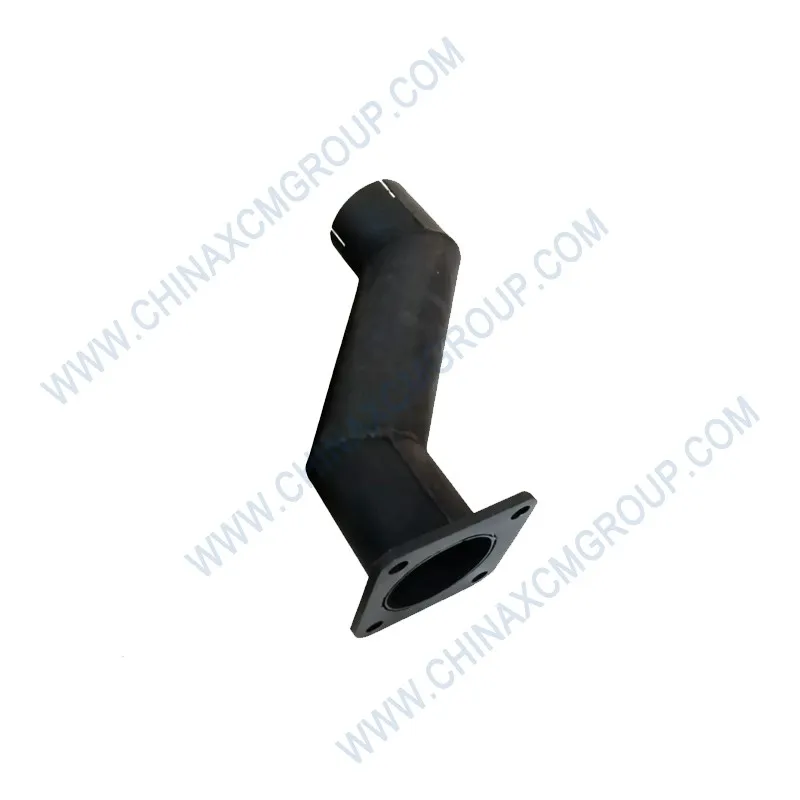


The genuine XCMG Exhaust Pipe with OEM number 332107392 is a heavy-duty turbocharger outlet pipe engineered for XCMG articulated dump trucks, wheel loaders, and off-highway equipment.
This pipe directs hot exhaust gases from the turbocharger to the diesel particulate filter (DPF) or exhaust after‑treatment system, ensuring optimal backpressure and emissions control.
Manufactured from high‑temperature stainless steel (304) with precision‑formed flanges, the XCMG 332107392 exhaust pipe withstands continuous temperatures up to 750°C and resists thermal fatigue and corrosion from exhaust condensates.
Its mandrel‑bent design ensures smooth gas flow, reducing backpressure and improving turbocharger response.
Designed for AD‑series trucks (AD45 through AD100), this pipe is a direct OEM replacement for original equipment, eliminating the need for custom fabrication.
The XCMG Exhaust Pipe 332107392 is a critical component that connects the turbocharger outlet to the DPF or exhaust after‑treatment system.
It withstands the intense heat and pressure of turbocharged exhaust gases, ensuring that the engine operates efficiently and meets emissions standards.
On AD60 and AD80 trucks, this pipe is subject to extreme thermal cycling, from ambient temperature to 750°C within seconds. A cracked or warped pipe can cause exhaust leaks, loss of turbo boost, and false DPF pressure readings.
Genuine XCMG pipes are mandrel‑bent, ensuring smooth inner walls that minimize backpressure and prevent turbulence. This preserves turbocharger response and fuel economy.
The 332107392 exhaust pipe is fabricated from 304 stainless steel, which offers excellent oxidation resistance at high temperatures and resists corrosion from exhaust condensates, road salt, and under‑hood chemicals.
Unlike mild steel, 304SS does not scale or flake, maintaining its structural integrity for the life of the machine.
The pipe is mandrel‑bent using a solid steel ball inside the tube during bending, which prevents kinking and maintains a constant cross‑sectional area. This reduces flow restriction compared to crush‑bent pipes.
The flanges are TIG‑welded to the pipe with full penetration welds, and the weld zone is ground smooth to eliminate stress risers. The flange faces are precision‑machined to ensure a leak‑tight seal with the gasket.
All surfaces are passivated after fabrication to remove any free iron and enhance corrosion resistance.
The XCMG exhaust pipe 332107392 is a direct OEM replacement for original part numbers 332107392A, 860124603, and 860298777.
The turbo side uses a standard 102 mm V‑band flange that mates with the turbocharger outlet. The DPF side uses a 2‑bolt oval flange with a metallic gasket (included).
The pipe also features a threaded boss for a pyrometer (exhaust gas temperature sensor) – a critical feature for monitoring DPF regeneration temperatures.
For AD100 trucks with larger turbochargers, a 127 mm diameter version is available (part 332107393). Always verify engine serial number before ordering.
The pipe also has mounting brackets for heat shields and exhaust supports, ensuring it does not sag or vibrate against other components.
To replace a cracked or leaking exhaust pipe, first allow the exhaust system to cool completely (below 60°C). Remove the V‑band clamp at the turbocharger outlet and unbolt the DPF flange bolts.
Support the pipe and remove it. Inspect the turbocharger outlet flange for cracks or warpage. Clean both flange surfaces with a wire brush.
Install the new XCMG 332107392 pipe with a new metallic gasket (included). Hand‑tighten the V‑band clamp and DPF bolts. Torque the V‑band clamp nut to 25 Nm, then after first heat cycle re‑torque to 15 Nm.
Tighten the DPF flange bolts to 40 Nm. Start the engine and check for exhaust leaks using a soapy water spray. Listen for hissing sounds.
Inspect the pipe every 500 hours for signs of cracking, especially near the welds. If the pipe shows blue discoloration, it has been subjected to extreme temperatures – plan replacement.
Service life in normal conditions is 8,000–10,000 hours. Replace the pipe if any crack is found, as even a small leak can cause DPF soot loading and regeneration issues.
Counterfeit exhaust pipes sold as 332107392 often use 409 stainless steel or even mild steel, which rusts through rapidly under high heat. Symptoms include surface rust, pinhole leaks, or cracks at the welds within months of installation.
Genuine XCMG pipes are fully 304SS, have a uniform matte finish, laser‑etched part number, and a holographic label on the packaging. The welds should be smooth and continuous.
Another common issue is incorrect flange orientation. Aftermarket pipes may have flanges welded at the wrong angle, causing misalignment and stress on the V‑band clamp. Genuine XCMG pipes are jig‑welded to ensure perfect alignment.
Lack of mandrel bending: Counterfeit pipes are often crush‑bent, causing a 20–30% reduction in inner diameter at the bend, increasing backpressure and reducing turbocharger efficiency. Inspect the inside of the bend – genuine XCMG pipes are smooth with no wrinkles.
The threaded boss for the pyrometer is often missing or incorrectly placed on counterfeit pipes. This sensor is essential for DPF regeneration control.
A cracked exhaust pipe can cause a drop in turbocharger boost pressure, resulting in reduced engine power and increased fuel consumption (up to 10% in severe cases).
Replacing a damaged pipe with a genuine XCMG 332107392 pipe costs approximately $185. This restores proper backpressure and fuel economy, saving hundreds of dollars in fuel annually.
More importantly, an exhaust leak before the DPF can cause the DPF to clog prematurely due to cooling of exhaust gases, leading to frequent regeneration events and eventual DPF replacement ($4,000+).
Predictive maintenance: During daily walkarounds, listen for a “chuffing” sound from the engine bay. Look for black soot marks around the exhaust pipe connections. If you see soot, the pipe is leaking.
Use an infrared thermometer to check the pipe temperature at various points – a sharp temperature drop indicates a leak. Replace the pipe every 8,000 hours as part of a major exhaust system overhaul.
Payback analysis: A genuine pipe costs ~$185. If it prevents one DPF replacement ($4,000) and saves 2,000 liters of fuel ($2,400), the ROI exceeds 30 times the cost. For fleets, proactive replacement eliminates unexpected breakdowns.
Every XCMG Exhaust Pipe 332107392 is manufactured in an IATF 16949‑certified facility. Each pipe undergoes 100% dimensional inspection, pressure testing, and visual weld inspection.
Random samples are subjected to 1,000 thermal cycles (ambient to 800°C), salt spray (500 hours), and vibration testing (100 hours at 30g). XCMG provides a 24‑month warranty against material defects, weld cracks, or corrosion perforation.
Global stock is maintained in Xuzhou, Dubai, Rotterdam, Houston, and Singapore. Emergency orders ship within 24 hours.
Bulk packs of 5 pipes (part number 332107392‑B5) are available for fleet customers at a 10% discount. Each pipe includes a new metallic DPF gasket and V‑band clamp nut.
To verify authenticity, scan the QR code on the packaging – it links to the test certificate showing material grade, weld penetration, and pressure test results.
Always insist on genuine XCMG 332107392; counterfeit pipes have been known to crack after only a few hundred hours, causing exhaust leaks and potential engine fire.
XCMG engineers tested the 332107392 exhaust pipe under extreme conditions: 10,000 thermal cycles from -40°C to +850°C, 2,000 hours of random vibration at 25g RMS, and 1,000 hours of salt spray (ASTM B117).
The pipe showed no cracking, no weld separation, and no measurable corrosion. The 304SS material retained its tensile strength and the flanges remained flat. The mandrel bends showed no thinning or wrinkling.
For applications with extremely high exhaust temperatures (e.g., engines with aggressive regeneration strategies), XCMG offers a 321 stainless steel version (suffix “-321”) that withstands 900°C continuous. This version is recommended for AD100 trucks in very hot climates.
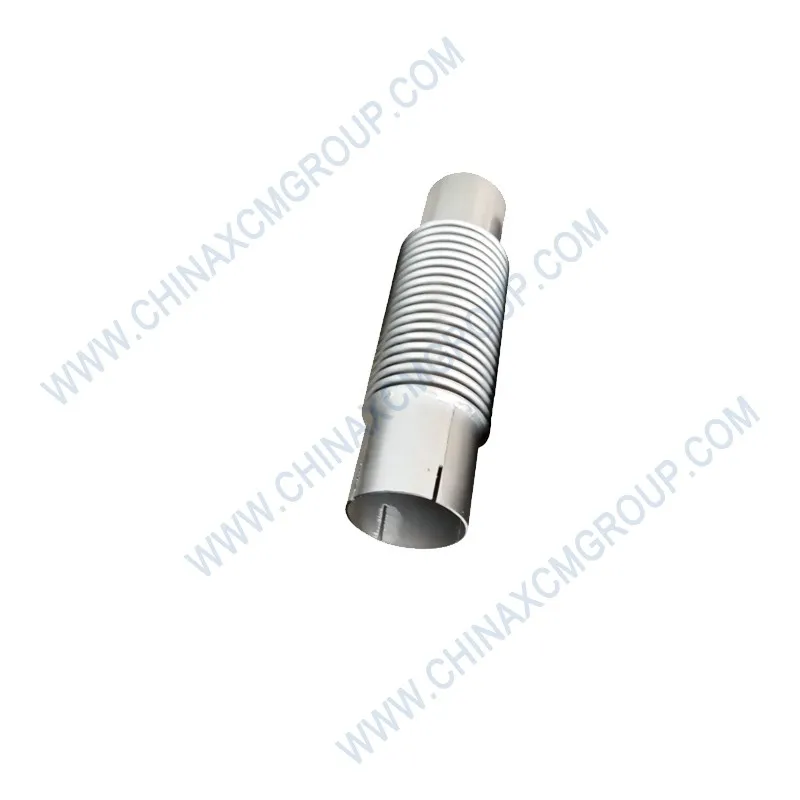
The pipe’s design includes stress‑relief loops and flexible bellows sections (on certain variants) to accommodate engine movement and thermal expansion, preventing stress fractures at the flanges.